Prana Vayu - The Five Vayus 1/2
In different yogic texts, the pranas are enumerated as 2, 3, 5, 6, 10, or even more, depending upon various considerations and ...
Transcript
Prana Vayu. In different yogic texts, the pranas are enumerated
as 2, 3, 5, 6, 10, or even more, depending upon various considerations. This is because the one prana works
in various ways and on various levels. Each of these classifications has
its own value and its own limitation. The pranas are most commonly referred to as
2 as prana and apana, which in yoga relate to inhalation and exhalation. Pranayama and the arising of the kundalini
are said to occur through the union of prana and apana in the navel. In Vedic texts, prana is said to build up
the mind and nerves, while apana builds up the body and bones. We could say that the mind is a product of
prana, while the physical body is a product of apana. This means that apana is not simply a negative
force as a power of elimination, but a positive force that creates
physical matter as well. This is not just a matter of the connection
of apana with the process of reproduction, though this is part of it. Relative to the breath, prana is oxygen, mainly
feeds the brain and mind, while the body and living tissue in general consists mainly of
carbon-based minerals that relate to apana. The prime blood circulation which carries
prana is to the brain, while the food that is digested, of which apana governs the culminating
stage in the large intestine, is mainly carbon-based. The positive side of apana in the body is
the bodily tissues, particularly their most subtle tissue, the reproductive one,
which has the power to create new life. The negative side of apana is the
urine and feces eliminated from the body. In this regard, apana builds the
datus of which ojas is the last product. The connection of positive apana and ojas is an
important consideration in yoga and ayurveda. Apana is the dominant prana at the physical
level and should be targeted as such in treating physical diseases. It is also responsible for absorbing
the prana or the energy from the food. It builds up the bones through its
connection to the large intestine. In ayurveda, most diseases are owing to vata,
which in turn are owing to apana that governs vata's site of accumulation
in the physical body. Prana meanwhile governs the mind, senses and
brain and the subtle forces of prana, tejas and ojas. This means that we must have a good, strong
and balanced apana vayu in order to practice pranayama in the
best possible manner. Otherwise there is the danger that we may become
ungrounded or vata deranged from pranayama practice. A good apana means good
ojas and proper nutrition. This serves as the vessel to attract
and hold the prana gained in pranayama. Additional Pranas Sometimes vyana or samana are added in yogic
texts as a third prana, governing retention of breath. Sometimes udana is added relative to
inhalation or speech instead of prana. And in some texts apana is divided into two
pranas as avana or the downward moving prana and apana or the
outward moving prana. These are just further diversifications
of the functions of prana. In yet another yoga texts all the five pranas
are discussed in details, just as in Ayurveda. All the sense organs including the eyes, ears
and even the mind are often called pranas in yogic texts. In the Upanishads there is a common story
about how the different faculties of the body argue among themselves over
which among them is the best. It is prana that wins the argument because
without it all the other faculties die. As prana rules the mind and
senses it has priority in yogic practice. Vyanavayu is a diffusive force. Physical location is in
heart and lips pervades body. The physical function is
movement and circulation. And the subtle function is
mental circulation and expansion. Udanavayu is ascending force. Physically is in the
throat and upper chest. The physical function is
speech, exhalation and growth. Subtle function is aspiration,
mental growth, enthusiasm and effort. Pranavayu is inward moving. Physically is the
heart and the brain. The physical function is swallowing,
inhalation, sensory perception. And the subtle function is
mental energization and receptivity. Samanavayu is equalizing. It's in the navel area, takes care
about the digestion and metabolism. And on the subtle level it is
mental digestion and homeostasis. Apanavayu is descending force. It's below the navel, takes care
about the elimination and reproduction. And on the subtle level it's mental
elimination and also immunity. Some efforts have been made to correlate the
five pranas with the five elements, and these may be accurate in various ways. However, we must remember that these five
pranas, five vayus, are all diversifications of the air element. They are also connected to the subtle air
element, the tanmatra, or sensory quality of touch, and the guna of rajas. In addition, the air element is
always connected to the ether element. We could say that air is space in motion,
while space is air at the condition of rest. This means that the pranas relate to spatial
and directional influences and to the subtle ether element, the tanmatra or sensory quality
of sound, and to the guna of sattva as well. The five pranas are common to all the elements,
organs, koshas, and functions of the mind. They serve to energize and to
connect our activities on all levels. Prana is the energizing and linking
force in the universe on all levels. It has both a vertical and
horizontal connecting movement. Relative to the five pranas. Prana brings about energization. Samana provides nutrition. Apana is responsible
for elimination. Prana governs circulation. Udana provides for effort
and the capacity to work. For example, on the physical level, prana
is responsible for eating food, samana for digesting it, vyana circulates the nutrition
to all the tissues, apana eliminates the waste material from the food, and udana allows us
to use the energy derived from the food for physical work. On the level of the mind, prana is responsible
for the intake of impressions and ideas, samana digests them, vyana circulates this information,
apana removes the waste material which is negative thoughts and emotions, and udana allows
us to do positive mental work and exertion. On a general level, prana energizes all the
koshas, samana sustains their relationship, cohesion and balance, apana brings energy
down the koshas from the subtle to the gross, udana brings energy up the koshas from the
gross to the subtle, and vyana brings about circulation through all the five koshas and
is responsible for their differentiation. On a more specific level, the physical body,
or anamaya kosha, is mainly under the rule of apanavayu. Apanavayu governs the information, building
up and destruction of the physical body. The pranamaya kosha, or vital body,
is mainly under the rule of pranavayu. The manomaya kosha, or mental sheet,
is mainly under the rule of udanavayu. Udanavayu governs speech and
the expressive power of the mind. The vijnanamaya kosha, or intelligence
sheet, is mainly under the rule of vyanavayu. Vyanavayu brings about
the expansion of intelligence. The anandamaya kosha, or bliss
sheet, is mainly under the rule of samana. Samanavayu brings about peace,
equanimity and bliss in samadhi. So there are five primary forces, pranic
force fields, known as panca prana, which operate in the physical
body at all times. Prana shakti, the one sustaining force, assumes
these five fields to enable the body to accomplish its various functions. Thus prana is experienced
differently in different parts of the body. These five forces also act on subtle levels,
influencing and in turn being influenced by the mind and consciousness. The seers identify these five pranas as
prana, apana, samana, udana and vyana. The five pranas are also
known as pranavayus. The term vayu is derived from the root
va, meaning motion, or that which flows. So the pranavayus represents the inherent
quality of motion, which energizes every action from secretion of the digestive
juices to the movement of the hand. They flow through all
elements, organs and the mind. The five pranas are responsible for creation
and existence at the individual level. In human beings they are created during the
first four months of development in the womb. During the first and second month,
the fetus lives on the prana of the mother. By the third month, the fetus
has its own battery installed. By the fourth month, the five physical pranas
become active with the information of the body, and the soul enters the new
body as a result of this pranic activity. The five pranas maintain the balance
between the physical and mental levels. Their physical locations are relevant in regards
to the functions of the body, however they function more homogeneously in the subtle
levels of mind and consciousness, where their distinction is qualitative
rather than physical. In this context, the yogic texts often differ
in their description of the five pranas and their locations. This should not
confuse the practitioner. One should remember that the energy body is
comprehended in the realm of experience, where the boundaries are
neither black or white. The key is to continue
honing one's own experience. Stula prana Prana is the
first of the panca pranas. This prana is also known as stula or gross
prana, to differentiate it from the all-pervasive vital force. Stula prana refers to the energy currents
located in the thoracic region between the diaphragm and the
base of the neck. It is the center of
circulation of life energy. This force maintains the heart and lungs,
and all the activities in the chest region, such as breathing, swallowing,
and circulation of blood. When the rate of breath or heartbeat increases
due to strenuous work, for instance the level of stula prana also increases. This force is so essential that if its activity
is obstructed or ceased for any reason, death may occur. Stula prana is experienced in the form of
light particles moving upwards, in the chest region. Among the fivefold pranas, it occupies the
pivotal position and controls the other four. Asthma in particular rises the level of this
prana and prevents congestion of blood in the arteries around the heart. When stula prana is strong, the heart does
not become weak, one does not suffer from high or low blood pressure,
and thus lives longer. At the level of mind, prana is responsible
for the intake of impressions and ideas. Prana energizes all the
koshas and is active all the time. It pervades the region from
anahata up to vishuddhi chakra. When the force of prana is strong and flowing
uninterruptedly, pure qualities of the heart, such as strength, courage,
and greatness are expressed. This prana is the energy by which one pointedness
of mind and intuitive knowledge can be experienced. It holds the intelligent energy of
the soul, which abides in the heart. By enhancing this prana,
the yogis reach the soul. In the Brihadaranyah
Upanishad it is said. The intelligent soul is placed
in prana, inside the prana. It pervades the prana, yet the
non-intelligent are unaware of it. Prana itself has become the body of the chief
master, who controls it from the inside. Thus the soul is immutable,
indestructible, and immortal. Prana is the guide and
medium for realization of the soul. When meditating on the heart center, the
identification with prana is most intense. One feels as if one
has become prana. When the pathways of prana are not clear,
the heart and lungs malfunction, and there is poor intake of oxygen. At the mental level, one is not
able to bring in positive impressions. It is difficult to concentrate
or access intuitive knowledge. Apana Apana is the second
prana, which operates in the pelvic region, between
the navel and the perineum. It sustains the functions of the kidneys,
bladder, bowels, excretory, and reproductive organs. It is responsible for the expulsion of
gas, wind, feces, urine, semen, and ova. It nourishes the fetus and expels it
from the uterus at the time of birth. Apana is experienced in the form of light
particles moving downwards from the navel to the perineum. Due to the presence of the earth and water
elements in this region, apana is felt as a heavy force. Apana brings energy
down through the koshas. Svadhisthana and Muladhara
chakras are within the range of apana. By realizing apana, these
chakras are also realized. The kundalini force lies within the periphery
of apana, and it assists in the awakening of kundalini, while prana
helps in its upward ascent. Thus maha prana is
experienced in the region of apana. Control of apana is also control of the sexual
instinct and the instilling of brahmacharya. At the mental level, apana removes
negative thoughts and emotions. Indications of imbalance is that when apana
is unbalanced, there is poor elimination, a feeling of being pulled down by
gravity, depression and negativity.
More practice
 The 5 Vayus: Apana Vayu practice- LauraGyogaLaura Goellner - Yoga Therapy · 18:33
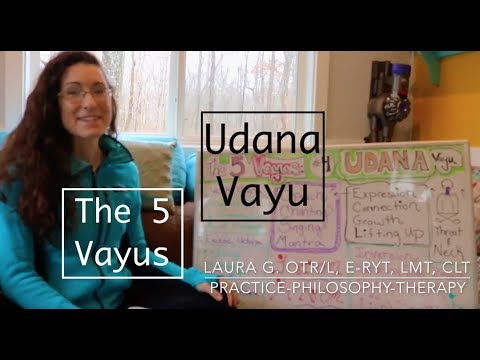 The 5 Vayus: Udana Vayu- LauraGyogaLaura Goellner - Yoga Therapy
 What is Prana Vayu · 5 Prana Vayus · What is Pranik Mudras ?Yoga Chaitanya
 Beginner's Guide to Meditation - Equal Rate Breath (Prana Style! 7-7-7)Healing Sense RMT Yoga
 Ep 2/2- Prana, Apana, Udana ,Samana, Vyana Vayu Made Simple - Easy Ayurveda AnimationsDr Sumit Kesarkar
 Food and Spirituality, the effects of food on consciousnessHot Yoga Stavanger
 Its very easy yoga gesture anytime anywhere do · Vayu mudra for joints pain and gastric problemRam Yogi